Intelligent systems
Designing responsible AI and robotics for future medicines operations
The most credible use of artificial intelligence and robotics in medicines operations begins with a narrow question: which defined task can be improved, under whose authority, with what evidence and what happens when the system is wrong?
That question is less dramatic than a fully autonomous laboratory. It is also more useful. Medicines work carries scientific, quality, safety and data consequences. Automation must therefore increase control and clarity, not obscure responsibility.
Automation is not autonomy
Robotics can move materials, repeat physical tasks, support instrument loading and improve consistency. Software can schedule work, monitor signals, detect patterns and support review. Artificial intelligence may help in defined analytical or operational contexts.
None of those tools becomes trustworthy merely because it is automated. The process still needs an intended use, accountable owner, defined inputs and outputs, performance criteria, operating limits, exception handling, records, change control and human authority.
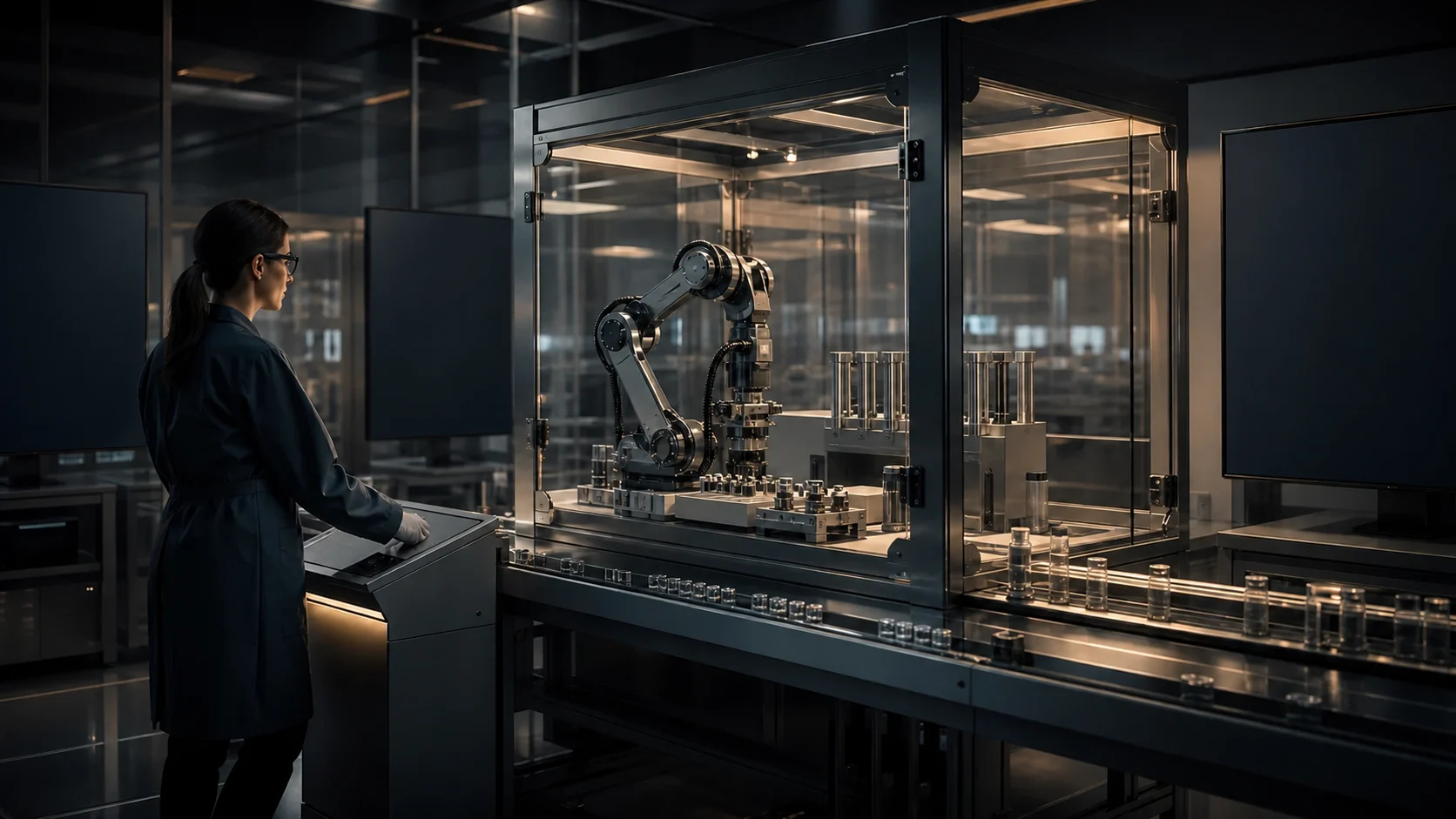
A glossy visual of a robot beside laboratory glassware provides no evidence of those controls. On the VARUNÉ Labs site, such imagery must remain explicitly conceptual.
Begin with context and risk
The NIST Artificial Intelligence Risk Management Framework organises AI risk work around four functions: Govern, Map, Measure and Manage. It is voluntary and not specific to medicines. It cannot replace United Kingdom regulation, pharmaceutical quality requirements or validation for a particular use.
Its value at concept stage is structural. Governance establishes responsibility. Mapping defines context, users, affected parties and possible harm. Measurement tests performance and uncertainty. Management sets priorities, controls and response.
This sequence helps resist a common error: choosing an impressive technology first and searching for a use later.
Good AI practice is life-cycle practice
In January 2026, the FDA and EMA published guiding principles of good AI practice in drug development. The principles emphasise human-centred design, risk-based oversight, a clear context of use, suitable expertise, traceable data governance, performance assessment, life-cycle monitoring and clear communication of limitations.
These principles do not approve any VARUNÉ system. They offer a useful lens for a future operating model.
An AI system may change because its data, environment, user behaviour, dependencies or model change. Control at launch is not enough. The organisation needs to know which version acted, what data informed it, how output was used, how performance is monitored and when a person must intervene.
Robotics creates a physical evidence problem
Robotics adds physical movement to digital risk. A proposed environment must consider access control, guarding, collision, contamination, cleaning, material identity, chain of custody, instrument state, calibration, recovery and safe manual operation.
The best first use may be repetitive and bounded. A robot that reliably transfers identified items under controlled conditions may create more value than a complex system attempting to direct an entire experimental programme.
Modularity matters. A failure in one cell should not make the whole environment unintelligible or unsafe. Interfaces, states and handovers should be visible to the people accountable for the work.
Sector interest is not proof of readiness
The Innovate UK competition Medicines Manufacturing Labs of the Future sought projects involving digital, automated and robotic technologies for pharmaceutical process development and manufacturing. The competition opened in April 2026 and closed in May 2026.
This is evidence that the area is of public innovation interest. It is not evidence that VARUNÉ applied, received an award, joined a consortium or owns any resulting technology.
Similarly, the MHRA Innovation Office provides a route for questions about innovative medicines and novel manufacturing approaches where regulatory uncertainty exists. Referring to that route does not imply engagement, advice or approval.
A proposed control model for VARUNÉ Labs
Any future VARUNÉ intelligent system should pass a documented sequence before operational use.
Define the decision
State the task, user, context, consequence and expected benefit. Identify decisions the system must never make.
Establish data authority
Identify source, permission, quality, lineage, retention and exclusions. Sensitive or regulated data should not enter a system merely because access is technically possible.
Design human control
Name the accountable owner, required review, override, escalation and safe state. Human oversight must be operational, not ceremonial.
Test performance and failure
Set relevant measures, acceptance criteria and challenge cases. Test drift, missing data, unusual inputs, physical faults and dependency failure.
Control deployment and change
Record versions, approvals, configuration and release state. Monitor performance in use and define when the system must pause, roll back or be retired.
Preserve an audit trail
Keep enough evidence to reconstruct what happened, which system acted, what a person reviewed and why a decision was accepted.
The proposed intelligent systems environment
VARUNÉ Labs currently presents an intelligent systems environment as a future campus concept. It may explore laboratory robotics, connected equipment, operational simulation and decision support. No system is represented as built, validated, deployed, autonomous or accepted by a regulator.
The purpose of the concept is to connect technology ambition with governance from the beginning. The strongest future system will not be the one that appears most autonomous. It will be the one that performs a valuable task, exposes its limits and remains under clear human authority.
Conclusion
Responsible automation is an operating discipline. It combines a useful context, traceable evidence, physical and digital controls, accountable people and continuous review.
For VARUNÉ Labs, artificial intelligence and robotics remain proposed areas of future capability. Their credibility will depend on what can be demonstrated safely and repeatably, not what can be rendered convincingly.
Questions and answers
What readers should know
- Does VARUNÉ Labs operate AI or robotics systems?
- No deployed or validated VARUNÉ system is claimed in this article. The intelligent systems environment is a proposed campus concept.
- Can AI make medicines decisions without human review?
- The appropriate level of review depends on the context, risk and applicable requirements. VARUNÉ proposes that future systems retain clear human authority, escalation and safe states.
- Is the NIST AI framework a pharmaceutical regulation?
- No. It is a voluntary general risk framework. It can support governance thinking but does not replace medicines regulation, quality controls or use-specific validation.
- Has VARUNÉ Labs received funding from Innovate UK?
- The proposed VARUNÉ Labs campuses are not presented as recipients of a campus award from this competition. A competition’s scope does not establish funding, validation or an operating capability for the programme.
- What would be required before operational deployment?
- A future system would need a defined purpose, authorised data, accountable ownership, risk assessment, performance evidence, appropriate validation, human control, change management, monitoring and any required approvals.
Source record
Sources and evidence
These references provide context only. A citation does not establish endorsement, partnership, site rights, access or approval for VARUNÉ Labs.
- NIST Artificial Intelligence Risk Management Framework
Published 26 January 2023. This is voluntary and not specific to medicines.
- FDA and EMA guiding principles of good AI practice
Published January 2026. Supports a life-cycle approach to AI in drug development.
- Innovate UK Medicines Manufacturing Labs of the Future competition
Opened 13 April 2026 and closed 28 May 2026. This competition page describes the funding call’s scope; it does not evidence a VARUNÉ campus award.
- MHRA Innovation Office
Updated 6 July 2026. It does not evidence VARUNÉ engagement, advice or approval.
- ICH Q9 Quality Risk Management
Adopted 18 January 2023. Supports the quality risk implications of digitalisation.