Scientific utilities
Capacity, quality, resilience and ownership would need to be defined for electricity, water, drainage, gases, thermal systems and connectivity.
Campus infrastructure
A credible science campus depends on utilities, controlled environments, secure data, safe movement and accountable operations. This page describes a proposed design framework. It does not represent installed infrastructure, confirmed capacity or an approved technical design.
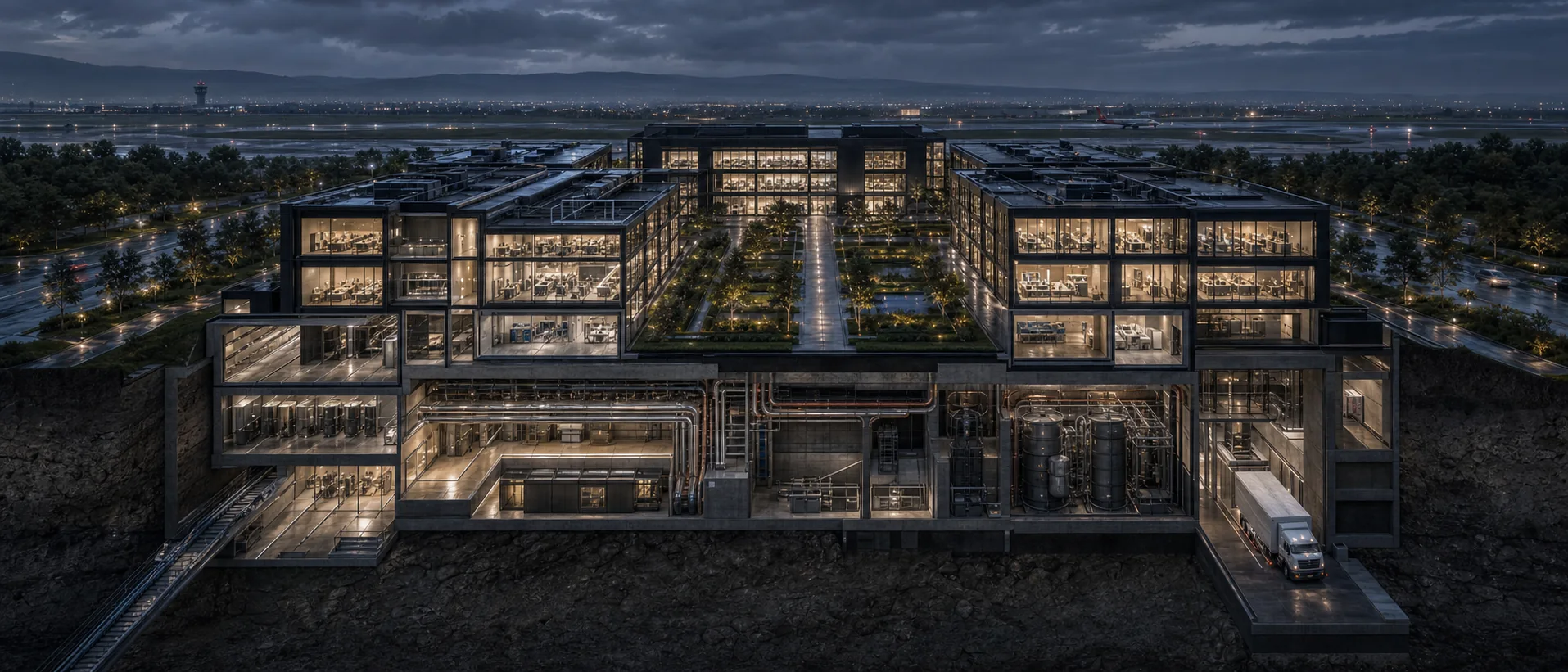
Campus systems
The sectional view connects space, utilities, movement, evidence and accountable operation as one proposed system.
One connected system
Each layer would be specified from intended users, sample types, process needs, equipment loads, safety controls and the decisions the work is meant to support.
Capacity, quality, resilience and ownership would need to be defined for electricity, water, drainage, gases, thermal systems and connectivity.
Environmental control, segregation and containment would follow the work proposed for each space and the risks that work creates.
People, materials, samples and waste would need distinct, understandable routes with appropriate checks at every controlled boundary.
Identity, equipment data, evidence records, access control and recovery would need one governed architecture rather than separate technology islands.
Deliveries, secure storage, calibration, maintenance, cleaning and waste collection would need to support science without compromising controlled work.
Critical activities would require defined tolerances, contingency routes, accountable response and evidence that recovery plans can work.
Utility evidence
The requirement, available capacity, quality, connection route, lead time, cost, contingency and operating owner would need to be verified for every critical service.
Confirm available capacity, reinforcement needs, lead times, critical loads, backup strategy, metering and accountable ownership before equipment or building design is fixed.
Define water quality, volume, heating, cooling, humidity and heat rejection requirements from the intended scientific and manufacturing use.
Establish discharge routes, treatment needs, monitoring responsibilities, consent requirements and safe failure states before a process is assumed feasible.
Determine which gases, compressed air, vacuum or other services are genuinely required, how they would be stored or generated and who would maintain them.
Test diverse connectivity, secure remote support, equipment integration, recovery needs and the boundaries between operational and business systems.
Controlled movement
Routes would be designed around real activities and risk assessments. They are not evidence that a particular material, sample or regulated activity will be present.
People. Staff, contractors, visitors and learners would enter only the spaces appropriate to their role, training and authorised purpose.
Materials. Incoming materials could move through receipt, identity checks, controlled storage, issue, return and reconciliation with traceable responsibility.
Samples. Samples could move through defined custody, condition, preparation, testing, retention and disposal steps linked to the relevant evidence record.
Waste. Waste routes would be designed around classification, containment, temporary storage, authorised collection and documentary closure.
Controlled environments
Temperature, humidity, particles, pressure, biological or chemical segregation, personnel protection and product protection would be set only after the intended activity and risk were understood.
Design intent alone would not be enough. Commissioning, monitoring, maintenance, cleaning, training, deviation response and accountable review would need to support the relevant use.
Digital foundation
The proposed architecture would separate appropriate business, scientific and operational systems while preserving authorised data exchange. Security, privacy, validation and retention requirements would follow the data and activity involved.
Logistics and resilience
Receiving, secure storage, internal delivery, calibration, maintenance, cleaning, consumables and waste collection would need planned routes, time windows and responsibilities.
Critical loads, sample conditions, data recovery, alternate suppliers, incident command and safe shutdown would be proportionate to the approved work and tested before reliance.
Activation tests
A failed test should cause the scope to pause, shrink, change sequence, remain external or stop.
The intended users, activities, materials, equipment and operating schedule must be specific enough to create a defensible requirement.
Ground, access, planning, safeguarding, environmental and utility evidence must support the proposed use and phased delivery route.
Utility availability, reinforcement, connections, consents and dependencies must be supported by accountable evidence rather than assumption.
Qualified designers and future operators must test containment, fire, occupational safety, maintenance, waste and emergency requirements.
Each critical system must have an accountable owner, competent operators, maintenance plan, records and escalation route.
Scope, cost, contingency, approvals, delivery authority and operating runway must converge before irreversible commitment.
Current boundary
No site utility capacity, connection, controlled environment, clean room classification, digital platform, logistics service or resilience system is represented as secured, installed, commissioned or operating.